
Chapter 5: Data-Driven Sports Betting · Lesson 3
By Cadell Griffith, Software Architect and founder of OddsFantasy · Updated · 8 min read
Bankroll management is the set of rules that decides how much of your betting money you stake on each bet, so that losing streaks can't wipe you out before your edge pays. Most bettors should stake 0.5–2% of their bankroll per bet: in the 20,000-run simulation in this lesson, quarter Kelly (1.14% a bet) kept the median drawdown to 24.8%, against 73.5% at full Kelly.
By the end of this lesson, you should be able to:
At the start of this course, you set aside some money. That money is your bankroll, the amount you have available to bet with.
As we emphasized before, your bankroll is your lifeline in betting. Risking it all on one bet is never a good idea. This lesson is about how to protect and grow that bankroll through bet sizing: deciding how much to wager on each bet.
Even with a positive expected value (EV) and the best odds, you will lose individual bets, often several in a row.
Losses are part of sports betting; the key is to protect yourself from large drawdowns and survive losing streaks.
🚨 That’s where bet sizing comes in.
Here are the six main bet sizing strategies used by professional punters, with their pros ✅ and cons ❌:
With flat bet sizing, you wager the same fixed amount on every bet.
With a $1,000 bankroll, you stake $10 on each bet.
✅ Pros:
❌ Cons:
You bet a fixed percentage of your current bankroll on every bet.
With a $1,000 bankroll, you stake 1% ($10). If the bankroll grows to $1,200, the next stake is $12; if it falls to $800, it is $8.
✅ Pros:
❌ Cons:
You define a target payout for every bet and adjust your stake to achieve it (stake = target payout ÷ odds).
Target payout = $20 per bet
✅ Pros:
❌ Cons:
This is a mathematical approach that finds the fraction of your bankroll that maximizes long-term growth for a given edge and odds:
Kelly fraction = EV ÷ (decimal odds − 1)
Stake = Kelly fraction × Kelly multiplier × bankroll
The Kelly multiplier scales the stake down; 0.5 is “half Kelly”, 0.25 is “quarter Kelly”. The 🔗 OddsFantasy Kelly Calculator does the sum for you.
From the previous lesson:
Step by step:
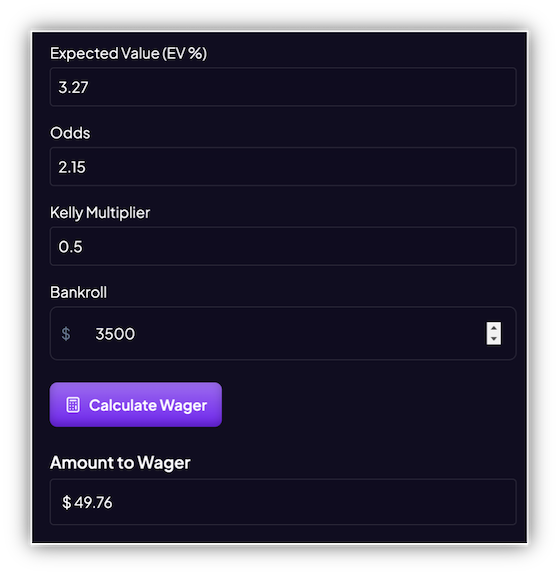
The calculator agrees: the optimal stake ≈ $50.
Kelly stakes shrink fast when the odds are short or the edge is thin. Under 2.5 goals in Egypt vs South Africa was a value bet at 1.613 with +1.13% EV:
With about a third of the baseball bet’s edge, it gets a full Kelly stake of 1.84% instead of 2.84%. Kelly divides the edge by the net odds (odds − 1), so the same edge earns a bigger stake at short odds, where the bet wins more often, and a smaller one at long odds.
| Multiplier | What it means |
|---|---|
| 0.10 | Extremely conservative; for unproven strategies |
| 0.25 (quarter Kelly) | The standard starting point: low volatility, strong drawdown protection |
| 0.50 (half Kelly) | Faster growth with moderate swings, once your probability estimates have a track record |
| 0.75 | Aggressive |
| 1.00 (full Kelly) | Maximum growth on paper, very large drawdowns |
| Above 1.00 | Overbetting: more risk and less growth (see the simulation below) |
Notice how small Kelly stakes are for real edges. The median value bet in OddsFantasy’s feed carries 1.9% to 3.3% EV depending on the bookmaker (see supported bookmakers). At odds of 2.10 and 2.6% EV, full Kelly is 2.36% of your bankroll and quarter Kelly just 0.59%.
✅ Pros:
❌ Cons:
You scale your stake based on how confident you are in your edge by adjusting the Kelly multiplier.
🔼 High confidence = higher multiplier
🔽 Low confidence = lower multiplier
If you’re new, start with a 0.25 Kelly multiplier.
It’s the standard low-risk setting, and the simulation below shows why.
Professional punters often combine multiple strategies. Hybrid bet sizing lets you build your own approach based on your risk tolerance.
OddsFantasy’s internal system combines proportional staking and confidence-based sizing to recommend stakes.
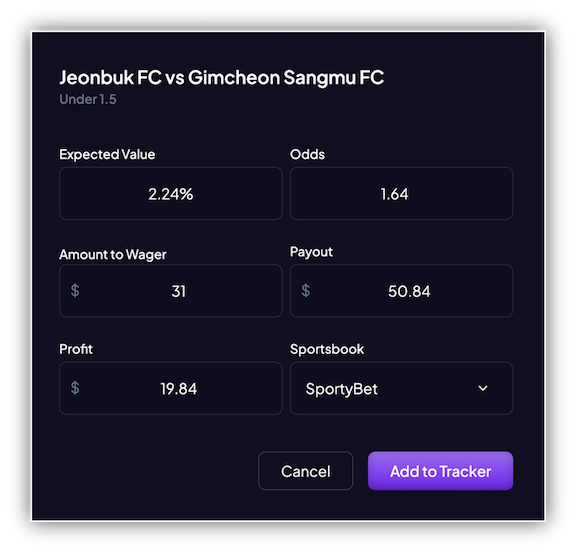
The proposed amount to wager on this bet, based on my bankroll, the odds, expected value and confidence, is $31.
How much does stake size really matter? We ran the same betting record 20,000 times with each strategy, using the formula behind the OddsFantasy EV simulator:
Every strategy bets on exactly the same wins and losses; only the stake changes.
| Strategy | Stake | Median final bankroll | Worst 10% of runs end below | Runs that lost money | Median max drawdown | Runs with a 50%+ drawdown |
|---|---|---|---|---|---|---|
| Flat | $10 | $1,500 | $1,080 | 6.8% | 18.2% | 0.9% |
| Proportional | 1% | $1,560 | $1,025 | 8.8% | 22.1% | 0.3% |
| Quarter Kelly | 1.14% | $1,644 | $1,020 | 9.6% | 24.8% | 1.0% |
| Half Kelly | 2.27% | $2,343 | $903 | 13.4% | 45.0% | 34.7% |
| Full Kelly | 4.55% | $3,111 | $462 | 23.6% | 73.5% | 97.2% |
| Double Kelly | 9.09% | $1,000 | $22 | 49.2% | 96.8% | 100% |
(Payout-target staking at fixed odds is the same as flat staking, so it isn’t listed separately.)
In the same simulation, the median longest losing streak over 1,000 bets was 9 losses in a row, and 39% of runs had a streak of 10 or more. That’s for bets that win half the time; at longer odds, streaks get longer still.
Here’s what 10 straight losses costs under each strategy:
| Strategy | Loss after 10 straight losing bets |
|---|---|
| Flat $10 | $100 (10% of the start) |
| Proportional 1% | 9.6% |
| Quarter Kelly | 10.8% |
| Half Kelly | 20.5% |
| Full Kelly | 37.2% |
| Double Kelly | 61.4% |
A streak like this will happen. Choose a stake size you can sit through without changing your plan.
Open the EV simulator and enter: true odds 2 and 2, betting odds 2.1, starting bankroll 1000, max bankroll per bet 10%, 1000 bets and a Kelly multiplier of 0.25, 0.5, 1 or 2. Use the same seed for each multiplier to compare them on identical results.
Even the best staking plan fails when discipline breaks. The four most common mistakes:
Gamblers judge themselves by single outcomes; bettors judge themselves by decisions. A staking plan is what turns one match into one data point among thousands.
In this lesson, you learned why bankroll management is essential and compared six bet sizing strategies. Even with good bets, poor stake sizing wipes out a bankroll: double Kelly turned a +5% edge into a coin flip on whether you make money at all.
✅ The safest approach for beginners:
Trade responsibly: only bet money you can afford to lose.
Knowing how to size your bets is only part of the puzzle. To improve your betting strategy and gain confidence in your results, you’ll need to track your bets.
In the next lesson, you’ll learn how to:
Between 0.5% and 2% of your bankroll per bet suits most bettors. In a 20,000-run simulation of 1,000 bets with a 5% edge, staking 1% to 1.14% (flat, proportional or quarter Kelly) kept the median maximum drawdown between 18% and 25%, while full Kelly at 4.55% led to a median drawdown of 73.5%.
Kelly fraction = EV ÷ (decimal odds − 1). Multiply it by your Kelly multiplier and your bankroll. For a bet at odds 2.15 with 3.27% EV, full Kelly is 0.0327 ÷ 1.15 = 2.84% of the bankroll; half Kelly on a $3,500 bankroll is about $50.
Yes, for almost everyone. Full Kelly grows the bankroll fastest on paper, but in our simulation 97.2% of full Kelly runs fell 50% or more from a peak at some point, and 23.6% finished below the starting bankroll. Half or quarter Kelly gives up some growth for far smaller drawdowns.
Overbetting destroys the edge. At double Kelly (9.09% per bet on a 5% edge), the median bankroll after 1,000 bets was back at its $1,000 start and 49.2% of runs lost money, even though every bet had positive expected value.
More than most bettors think. Over 1,000 bets that each win 50% of the time, the median longest losing streak was 9 bets and 39% of runs had a streak of 10 or more. Ten losses in a row costs 37.2% of the bankroll at full Kelly and about 11% at quarter Kelly.
Big enough that a single stake is 1–2% of it at the stake size you want to bet, and money you can afford to lose entirely. If you want to bet $10 a time, that means a bankroll of $500 to $1,000.