
Chapter 4: Inside Bookmaking · Lesson 1
By Cadell Griffith, Software Architect and founder of OddsFantasy · Updated · 5 min read
Bookmaking is the business of setting odds on sports outcomes, taking bets at those odds and paying out the winners. A bookmaker prices every outcome a little below its true chance, so the implied probabilities add up to more than 100%: on a coin toss priced at 1.90 for each side, $100 bet on heads and $100 on tails leaves the bookmaker $10 profit whichever side lands.
By the end of this lesson, you will:
You now understand what you see on a bookmaker’s website: sports, events, markets, outcomes, odds and the bet slip. The next step is learning how those markets and odds are created in the first place. Once you know how a bookmaker builds its prices, you know where those prices can be wrong.
For the next few lessons, you’ll step into the bookmaker’s shoes. Then we’ll look at betting again from the punter’s side, with the bookmaker’s tricks in your pocket.
A bookmaker doesn’t need to know who will win. It makes money from two things:
Here is the Money Line on Schwarz-Weiss Bregenz vs FC Liefering (Austria, 2. Liga) at two bookmakers, from the OddsFantasy Positive EV tool:
| Bookmaker | Bregenz win | Draw | Liefering win | Implied total | Margin |
|---|---|---|---|---|---|
| Pinnacle | 2.58 | 3.93 | 2.42 | 105.53% | 5.24% |
| Stake | 2.60 | 3.60 | 2.20 | 111.69% | 10.47% |
If bettors stake $10,000 on this match in proportion to the odds, Pinnacle pays back $10,000 ÷ 1.0553 = $9,476 whichever team wins and keeps $524. Stake pays back $10,000 ÷ 1.1169 = $8,953 and keeps $1,047: twice as much from the same match, paid for by its customers through worse odds.
The margin is a cost to every bettor. That’s why the sharp vs soft bookmakers lesson matters: where you bet decides how much of every stake you hand over.
Setting odds is a four-step process:
For the Bregenz match, OddsFantasy’s fair (no-vig) odds were 2.723 / 4.147 / 2.554, which is 36.7% / 24.1% / 39.2% and adds up to 100%. Pinnacle divided each fair price by its overround of 1.0553:
Those are exactly the prices on its board. Run the sum backwards (multiply each price by 1.0553) and you get the fair odds back. The overround and margin lesson shows this method and the equal-share method the vig calculator uses.
Soft bookmakers often skip step 1. They copy a sharp bookmaker’s price, add a bigger margin and update it later. That delay is where value bets come from.
In real sports betting, bookmaking takes a lot of data. To see the mechanics, use an event whose probabilities you already know: a coin toss 🪙.
The first step in bookmaking is choosing the event: a coin toss.
Next, choose a market: “Face Up”, which side of the coin faces up after the toss. (You could also offer “Face Down”; even a coin toss has several markets.)
List every outcome of the market:
Work out the probability of each outcome:
Add the probabilities together. If the sum is 1, you’ve covered every outcome: 0.5 + 0.5 = 1 ✅
Convert the probabilities into odds: Decimal Odds = 1 ÷ Probability
✅ You’ve made a simple book:
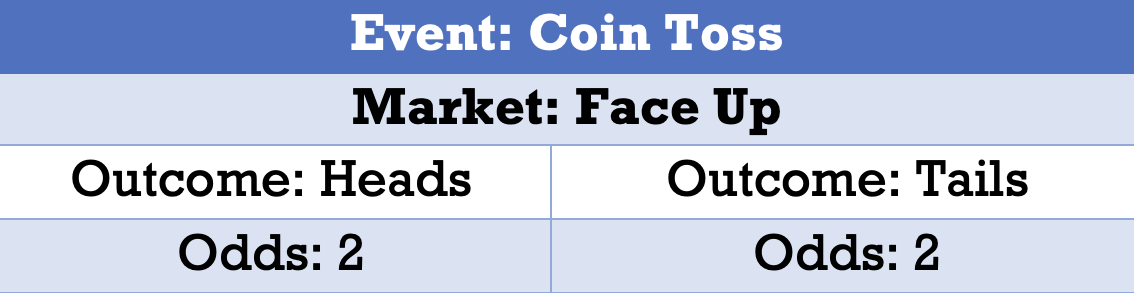
Your book is correct, but you can’t run a business on it yet.
Two punters each bet $100 on your book, one on Heads and one on Tails. Your market liquidity, the total money staked on the market, is $100 + $100 = $200.
One of them wins: Payout = Odds × Stake = 2 × $100 = $200. You pay out everything you took in and keep $0. ☹️
The fix is the margin: price each side at 1.90 instead of 2.00 and the same two bets leave you $10, as in the example at the top of this lesson.
Now the punters stake $100 on Heads and $105 on Tails. Market liquidity is $205.
👉 That’s gambling, and a bookmaker doesn’t gamble. It fixes this with stake limits and by moving its odds to attract money to the lighter side, which are the next two lessons.
A bookmaker takes the other side of your bet. A betting exchange (Betfair) or prediction market (Polymarket) doesn’t: it matches you with other bettors and earns a commission or trading fee instead of a margin in the odds. You’ll compare all three in sharp vs soft bookmakers, and you can trade Polymarket’s sports markets from the free OddsFantasy terminal.
Build a book for a different event, such as rolling a die (six outcomes at 1 ÷ 6 each). Price every outcome at fair odds, then cut each price by 5% and work out how much you keep if $100 lands on every number.
In the next lesson, you’ll measure the margin itself: how the odds of a market add up to more than 100%, the difference between overround and margin, and how to strip it out to get the fair odds.
Bookmaking is the business of setting odds on the outcomes of an event, accepting bets at those odds and paying the winners. The bookmaker prices every outcome slightly below its true chance, so it keeps a margin from the total staked whichever outcome happens.
From the margin built into their odds. The implied probabilities of a market add up to more than 100%, and the excess is the bookmaker's cut. On a real Austrian 2. Liga match, Pinnacle's margin was 5.24% and Stake's 10.47%: on $10,000 staked in proportion to the odds, Pinnacle keeps about $524 and Stake about $1,047.
They estimate the true probability of each outcome from models, team and player data and other bookmakers' prices, add their margin, open the market with low limits and then move the odds as money and news arrive. Many soft bookmakers skip the modelling and copy a sharp bookmaker's price with a bigger margin.
A balanced book has money on each outcome in proportion to its odds, so the bookmaker pays out the same amount whichever outcome wins and keeps the margin. When too much money lands on one side, the bookmaker shortens that side's odds and lengthens the other to attract balancing bets.
Yes, on single events. If a book is unbalanced and the heavily backed outcome wins, the bookmaker pays out more than it took in on that market. Margins, stake limits and line movement keep those losses small and the profit steady over thousands of markets.
A bookmaker sets the odds and takes the other side of your bet. A betting exchange or prediction market, such as Betfair or Polymarket, matches you with other bettors and charges a commission or fee instead of building a margin into the odds.